The Epicurean Entrepreneur
Modern entrepreneurial culture has absorbed many Stoic lessons. Founders are told to endure uncertainty, control their reactions, persist through failure, ignore criticism, remain disciplined, and accept that outcomes are never fully within their control. These are valuable and timeless lessons for anyone trying to do hard things. Anyone who undertakes to build a company will need them. A business exposes its creator to risk, volatility, disappointment, competition, and humiliation. Stoicism teaches the entrepreneur a way to not be destroyed by those things.
But endurance is not enough.
A founder can endure a raft of pointless burdens. He can persist in a project that should be abandoned. He can mistake compulsion for discipline, anxiety for responsibility, growth for freedom, and self-exploitation for virtue. He can become skilled at carrying the stone without asking whether the stone should still be carried.
This is why Epicurus may be the more neglected guide for the entrepreneurial life.
Stoicism teaches the founder how to remain free when circumstances resist his purposes. Epicureanism asks whether those purposes are actually making him free in the first place.
That question is not a retreat from ambition. It is one of the hardest questions a founder can ask because entrepreneurship often presents itself as the pursuit of freedom while quietly generating new forms of bondage. The founder leaves the hierarchy, rejects the ready-made role, and creates the institution rather than merely inhabiting it. Yet before long, the company he created may govern him more completely than any boss ever did or ever could.
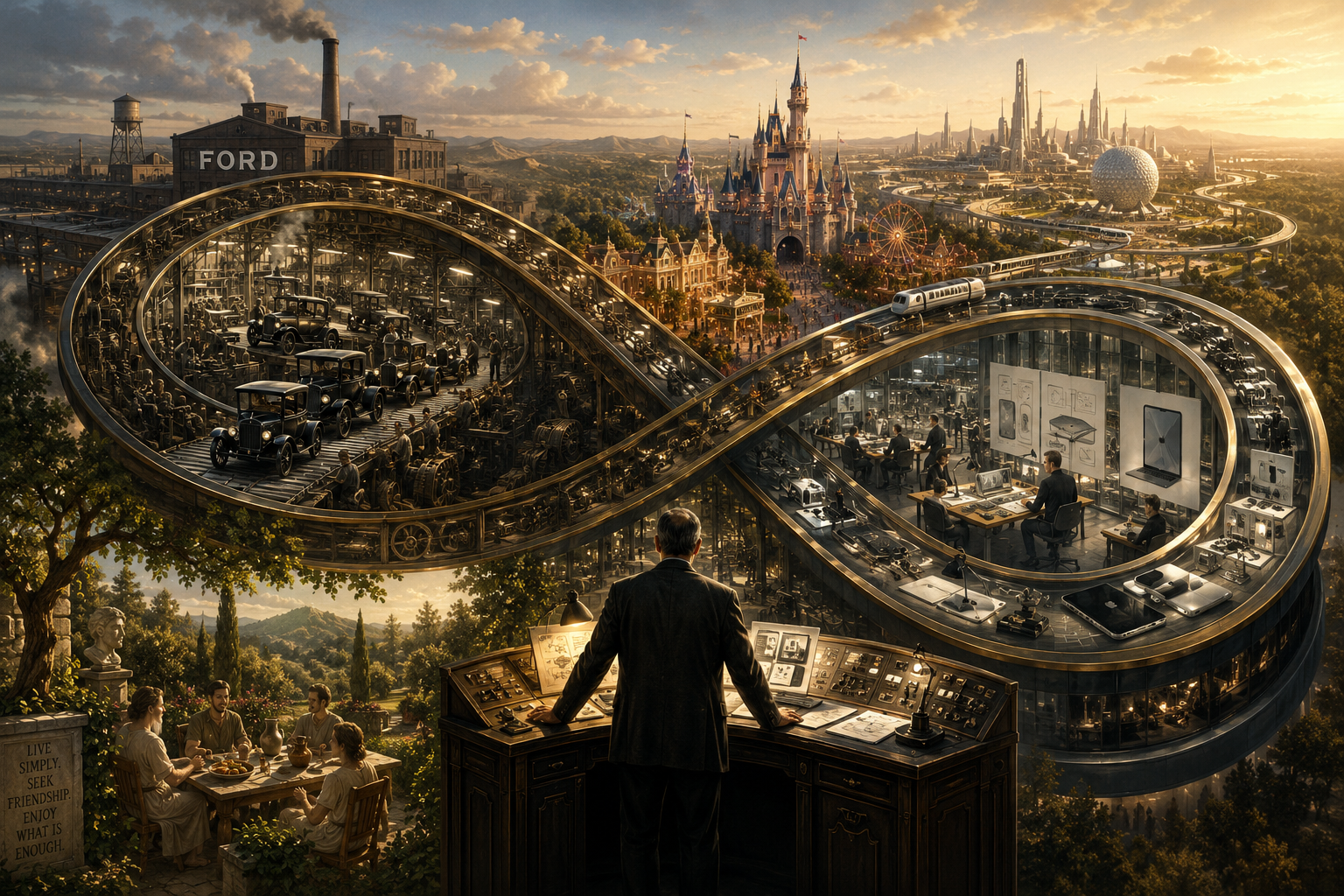
The lives of Henry Ford, Walt Disney, and Steve Jobs help us see why.
Ford, Disney, and Jobs are not interesting merely because they were successful. They are interesting because each represents a distinct kind of entrepreneurial absorption. Ford was absorbed by the system: the machine, the process, the factory, the scale that could make a product available to the masses. Disney was absorbed by the power of imagination: the story, the character, the environment, the fantasy place made visible and inhabitable. Jobs was absorbed by the objects of thoughtful design: the product as an expression of taste, integration, simplicity, and manifest desire.
Each built something extraordinary. Each also shows how the founder’s gift can become inseparable from a danger. The very power that allows a founder to create may also prevent him from knowing when creation has become compulsion.
As with many iconic entrepreneurs, Ford, Disney, and Jobs were never really chasing money. Obsessives are more often focused on larger prospects. In fact, their businesses became fields of attention so compelling that ordinary categories of work and reward hardly explain them. They built because the act of building had become the central drama of their lives.
That is what makes them useful examples for an Epicurean philosophy of entrepreneurship. Epicurus does not merely warn us against crude indulgence. He warns us against desires that become unlimited because they contain no natural measure of completion.
The founder’s deepest danger is often not be greed in the most ordinary and petty sense. It may be the inability to say what ever would count as enough.
Ford and the Tyranny of the System
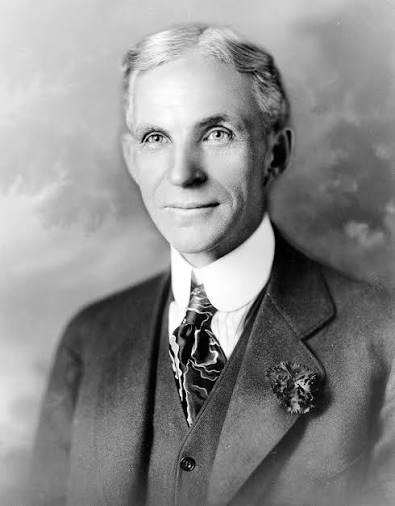
Henry Ford’s genius was not merely that he built cars. It was that he understood production as a system.
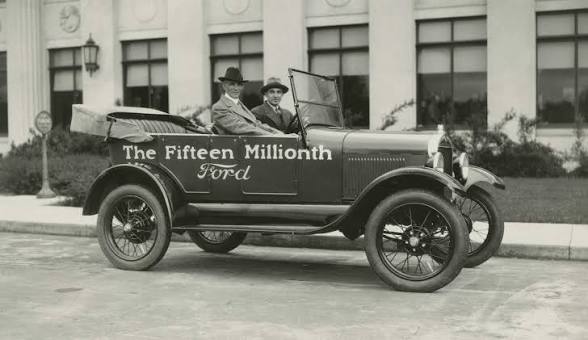
The Model T mattered not only as a vehicle but as the visible outcome of a vast act of simplification. Ford’s great question was how to make a complex machine repeatable, affordable, repairable, and available at a scale that changed ordinary life. The moving assembly line, standardized parts, disciplined production, and high volume did not merely make Ford rich. They changed the relationship between Americans, work, distance, wages, and consumption.
This is entrepreneurship as system-building. It illustrates why the entrepreneurial life can be so absorbing. A system is not just a product. It is a world of relationships: raw materials, machines, workers, time, cost, logistics, customers, dealers, roads, repairs, wages, and prices. To master such a system is to experience a particular kind of intellectual power. The founder begins to see how scattered realities can be ordered toward a practical end.
There is real pleasure in this. It is not merely vanity. It is the pleasure of making something first intelligible, but then to see to it that the intelligible is then made operational.
But Ford also shows how the founder’s gift can become tyrannical. The discipline that makes a system possible can harden into domination. The founder who discovers one great simplification may begin to distrust variety itself. Difference looks like waste. Dissent looks like inefficiency. Human complexity and human relationships looks like a problem to be engineered away.
The cost to Ford was not merely organizational. It was personal.
Ford’s relationship with his son Edsel is one of the great cautionary stories of founder psychology. Edsel was not an enemy of the company. He was its president, Henry Ford’s only child, and in many ways a man of broader taste and more humane instincts. Yet he was repeatedly constrained, overruled, and humiliated by the gravitational force of his father’s authority. Edsel wanted design, refinement, responsiveness to changing markets, and a company capable of evolving beyond the assumptions that had made the Model T great. Henry Ford too often treated such difference not as the contribution of a son and executive, but as a threat to the original system.
Here the Epicurean question becomes painfully concrete. What is the good of building a company that mobilizes thousands if the founder cannot sustain a sane relationship with his own child? What kind of freedom has been achieved if the enterprise makes ordinary trust and familial generosity harder rather than easier?
The problem deepened in Ford’s reliance on Harry Bennett, the rough enforcer who became one of the most destructive figures in the company’s internal life. Bennett’s role reflected more than a personnel mistake. It revealed a founder’s unhealthy relationship to power. Ford’s suspicion, need for control, hostility to organized labor, and willingness to use fear as a management instrument all found an organizational expression through Bennett.
This is one of the clearest ways a founder’s inner disorder becomes institutional. The founder’s anxiety becomes a security department. His distrust becomes a personnel system. His fear of losing control becomes someone else’s daily intimidation.
Ford’s system served real goods. It made mobility affordable and transformed modern life. But the same system also reveals the danger of a founder whose desire for order outruns the human goods order is meant to serve. The company becomes not merely a means of production, but an extension of the founder’s will.
Epicurus would not deny the achievement. He would ask whether the system increased freedom or created a new form of dependence. Did it satisfy a real human need, or did it become an expanding structure that had to be fed, defended, and obeyed? Did the founder possess the company, or did the company, through his need for control, really possess him?
Ford’s tragedy is that the system he built was brilliant enough to change the world and powerful enough to deform the human relationships closest to him.
Disney and the Creativity Spiral
Walt Disney’s entrepreneurial imagination was different.
Ford was drawn to system. Disney was drawn to world building.
Animation already requires this kind of creativity in that it gives motion and personality to what would otherwise be lines, drawings, voices, and music. Disney grasped that popular imagination could be organized with extraordinary care. Character, story, color, sound, environment, merchandising, and memory could belong to one coherent experience.
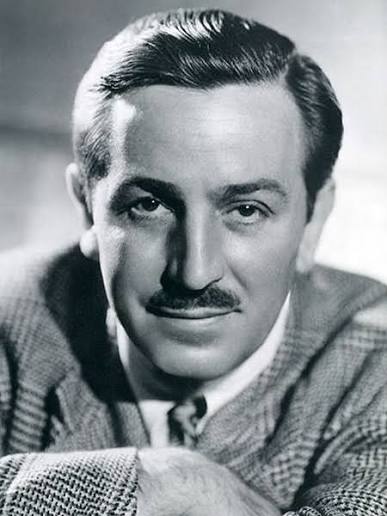
Then the world expanded. The studio was not enough. The film was not enough. The characters were not enough. Disneyland became a physical world in which narrative, architecture, cleanliness, movement, hospitality, technology, and commerce could be integrated into an experience. Disney’s imagination did not remain on the screen. It became a physical place.
This, too, shows the dignity of entrepreneurship. A business can be a means of making imagination public. It can gather artists, engineers, builders, operators, financiers, and audiences into a shared project. It can produce delight for audiences. It can create forms of cultural memory. It can build places people carry in their minds for the rest of their lives.
Disney is also important because his founder story is not simply Ford’s story repeated in a different industry. He seems to have had a better relationship with family, and especially with his brother Roy, whose financial discipline and steadiness helped make Walt’s imaginative risks possible. Roy Disney matters philosophically because he represents something many founders desperately need: a counterweight. Walt dreamed, pushed, expanded, and imagined. Roy translated, financed, moderated, and protected.
That partnership suggests a healthier possibility than Ford’s lonely domination. A founder may need someone near him who can say no, not as an act of betrayal, but as a condition of preserving the enterprise and the founder himself.
And yet Disney also shows a different danger: not the tyranny of system, but that of the creativity spiral.
The creative founder is tempted not simply by money or status, but by the next realization of imagination. The question “What else could this become?” is the engine of creative entrepreneurship. It is also the beginning of restlessness.
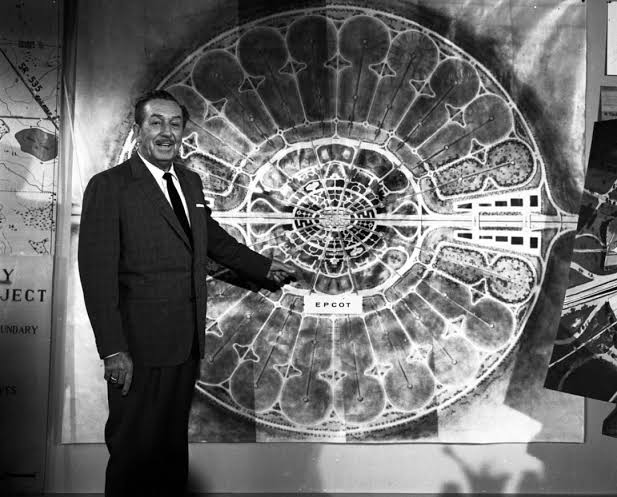
The cartoon becomes the feature film. The feature film becomes the studio. The studio becomes television. Television becomes the park. The park becomes a larger resort. The resort becomes the dream of EPCOT: not merely an attraction, not merely entertainment, but an experimental city of tomorrow, a total environment in which transportation, housing, commerce, technology, and social life might be redesigned.
One can admire the ambition and still see the danger. EPCOT, in Walt Disney’s original imagination, was not simply a business expansion. It was world-building on the edge of political and social fantasy. It suggested a founder’s desire to extend creative control beyond entertainment into life itself.
Here the Epicurean question is not whether imagination is good. Of course it is. Nor is the question whether Disney’s ambitions produced real delight and cultural value. Plainly they did. The question is whether creative desire has a natural limit.
For Disney, the imagined world always seemed to disclose a larger world beyond it. The horizon kept moving. The very success of one act of creation revealed the insufficiency of the container that held it. Animation wanted film. Film wanted place. Place wanted city. City wanted future.
This is the founder’s creativity spiral. It is not empty in the crude sense. It may be filled with genuine goods: beauty, delight, invention, collaboration, and public imagination. But it can still become disordered if every realized dream immediately becomes the platform for a larger demand.
Disney’s example therefore complicates the Epicurean argument. The problem is not that the founder wants something worthless. The problem is that even worthy desire can become unlimited. A dream can be noble and still devour the dreamer.
Jobs and the Perfection That Cannot Trust
Steve Jobs represents a third form of entrepreneurial absorption.
Ford’s imagination centered on the system. Disney’s centered on world-making. Jobs’s centered on the ways that functionality and restrained design intersect.
In the most expansive sense, Apple’s products were always embedded in software, retail, branding, manufacturing, and culture. But Jobs’s distinctive power lay in treating the product as a unified experience. The device was not merely a tool. It was an expression of taste, simplicity, control, and desire.

Jobs understood that people do not merely use objects. They live with them. They identify with them. They judge themselves and the world through them. A product could be functional and also intimate, technical and also emotional, mass-produced and also personal.
This, again, is not a trivial form of ambition. The making of a beautiful and useful object can be a genuine human good. To bring simplicity out of complexity, to make technology approachable, to insist that function and beauty belong together—these are not merely commercial acts. They can be acts of practical imagination.
But Jobs also shows the danger of perfection without trust.
His career repeatedly involved conflict with the structures that were supposed to govern or contain him: boards, executives, managers, and teams. The famous struggle at Apple in the 1980s was not only a corporate governance episode. It expressed a deeper founder problem: what happens when the person whose vision animates the company cannot live peacefully with the authority of anyone else over that vision?
This problem did not vanish simply because Jobs was often right about products. Being right can intensify the danger. The founder who sees what others miss may gradually conclude that disagreement itself is evidence of inferiority. The board is too cautious. The executives are too conventional. The employees are not demanding enough. The customers do not yet understand. The world must be forced to recognize what the founder already knows.
People don’t know what they want until you show it to them.”
Steve Jobs
Jobs also illustrates a paradox common among brilliant founders: he wanted the best people, but often struggled to trust them in ordinary human terms. He could gather extraordinary talent, inspire it, focus it, and drive it toward achievements that would otherwise have seemed impossible. But the same intensity that drive innovation could create a toxic atmosphere in which people were treated less as collaborators than as instruments for realizing his solitary vision of the product.
The Epicurean question here is not whether excellence requires standards. It does. Nor is it whether demanding people can produce better work. They often can.
The question is whether the pursuit of excellence has become hostile to other goods such as friendship, trust, and peace of mind.
“Be a yardstick of quality. Some people aren’t used to an environment where excellence is expected.”
Steve Jobs
Jobs’s great strength was his refusal to accept the mediocre object. His danger was that the imperfect person could become intolerable because every imperfection threatened the object. Taste became judgment; judgment became control; control became a way of being with others.
This is the founder’s perfectionist temptation. The object is loved so intensely that people are judged by whether they advance or obstruct it. The company hires the best, then teaches them that being the best may still not be enough to earn trust.
Epicurus would not ask whether the product is beautiful. He would ask whether the desire that produced it is capable of tranquility. Aristotle would not ask only whether the work is excellent. He would ask what kind of character is formed by the manner of its making.
Jobs forces the hardest version of the question: Can a founder produce a product that will enrich human life while practicing forms of leadership that diminish the lives nearest to him?
The answer may be yes. History is full of such contradictions. But the contradiction should trouble us.
The Business as an Absorbing Good
At this point, many restless founders will raise an important objection.
They may say that talk about balance, tranquility, sufficiency, and limits misunderstands the actual experience of entrepreneurship. For some people, the business is not merely a means to money, security, prestige, or lifestyle. The activity of building, managing, improving, and directing the enterprise is itself the most absorbing thing they do.
The founder does not merely want what the business produces. He wants the business itself: the problems, the decisions, the systems, the risks, the people, the strategy, the competition, the constant need to notice, judge, adapt, and act.
For such a person, the company is not a burden imposed from outside. It is a field of attention more compelling than almost anything else. The founder may not be sacrificing a better life to the business. He may experience the business as the place where his intelligence, energy, judgment, and imagination are most fully alive.
Ford, Disney, and Jobs personify this objection.
For Ford, the business was not merely a way to sell cars. It was a way to solve the problem of production itself. For Disney, the business was not merely a way to sell entertainment. It was a way to give form to imagined worlds. For Jobs, the business was not merely a way to sell devices. It was a way to impose coherence, beauty, and emotional force on modern technology.
To say simply that such founders should have “balanced” their lives may be true in one sense but shallow in another equally vital sense. It misses the fact that the business itself may have been the arena in which their capacities were most fully exercised.
This is why an Epicurean critique of entrepreneurship must not become a small philosophy for small ambitions. It must be able to admit that business can be a genuine object of love.
The enterprise may be, for the founder, what a mathematical problem is for a mathematician, a symphony for a composer, a case for a lawyer, or a difficult text for a scholar. It may be a living problem of order, value, risk, and judgment. It may be the place where the world becomes most vivid.
If so, the pleasure is not obviously empty. It may be deep and genuinely connected to the exercise of the founder’s powers.
But the objection does not defeat the Epicurean question. It actually refines it.
The question is not whether the business can be intrinsically absorbing. It plainly can. The question is whether absorption is the same as flourishing.
An activity may capture the mind without ordering the life well. Gambling can be absorbing. Conflict can be absorbing. Status competition can be absorbing. Crisis can be absorbing. A person can be fascinated by the very thing that deforms him.
The founder therefore has to ask not only, “Does this business hold my attention in a way that nothing else can?” but also:
- Does this activity leave me more free or less free?
- Does it deepen my judgment or merely sharpen my appetite?
- Does it cultivate the goods of friendship, trust, and generosity, or does it crowd them out?
- Does it reduce fear or organize my life around fear?
- Does it make me more capable of enjoying simple goods, or less capable?
- Can I step away from it without feeling that my selfhood has been threatened?
- Is my absorption in the work chosen, or has it become compulsory or addictive?
The more fascinating the enterprise becomes, the easier it is to mistake intensity for completeness.
The founder may not be trapped because the work is empty. He may be trapped because the work is so full that it begins to exclude everything else.
The Problem of Enough
Modern business culture has many theories of growth and few theories of enough.
It teaches founders to scale, optimize, expand, automate, dominate, differentiate, and compete. It offers strategies for hiring, marketing, financing, pricing, delegating, and exiting. It is highly articulate about more.
It is much less articulate about understanding sufficiency.
Without a theory of enough, success cannot bring peace because success has no defined destination. The founder never arrives because arrival was never specified or given conditions.
Ford, Disney, and Jobs each illustrate a different version of this problem.
For Ford, “enough” was difficult because a system can always be made more efficient, more extensive, more controlling, more complete. Once the founder sees waste everywhere, the work of elimination never ends.
For Disney, “enough” was difficult because imagination always discloses another world beyond the present one. The cartoon becomes the feature, the feature becomes the studio, the studio becomes the park, the park becomes the planned city. The imaginative horizon keeps moving.
For Jobs, “enough” was difficult because taste keeps seeing the flaw. The product can be simpler, cleaner, more integrated, more intuitive, more inevitable. Perfection retreats as one approaches it.
These are not merely business problems. They concern the ordering of desire within a human life. The founder’s defining excellence—Ford’s appetite for system, Disney’s generative imagination, Jobs’s demand for refinement—does not simply expose him to temptation from the outside. It creates a temptation from within, because the very disposition that produces extraordinary work is continually rewarded until it begins to present itself as the measure of everything else.
What began as a capacity in service of a good can become a ruling principle: order becomes control, imagination becomes totality, and taste becomes perfectionism. The founder’s central gift then ceases to be one excellence among others and begins to demand the subordination of family, friendship, trust, rest, and ordinary human limits.
Epicurus gives us a language for this. The danger is not desire as such. The danger is desire without a natural limit.
An Epicurean entrepreneur must therefore ask:
- What would count as enough growth?
- What would count as enough control?
- What would count as enough recognition?
- What would count as enough refinement?
- What would count as enough security?
- What must remain outside the claims of the business?
The point is not that small is always better than large. Ford’s achievement required scale. Disney’s imagination required institutions capable of sustaining large collaborative work. Jobs’s products required global systems of design, manufacturing, distribution, software, and retail.
Scale can be justified. Growth may produce resilience, usefulness, opportunity, and good work for others.
But growth must remain answerable to a prior account of the good.
A company that grows in order to become more stable, useful, humane, and free may be growing wisely. A company that grows because growth has become the only available definition of success is no longer governed by practical judgment. It is governed by appetite.
The discipline of enough is not the enemy of excellence. It is the condition under which excellence can remain connected to a broader and richer life that makes room for a wider range of virtues.
Fear and the Founder’s Organization
Epicurus was centrally concerned with fear. He wanted to free human beings from fear of death, fear of divine punishment, fear of poverty, fear of pain, and fear of exclusion. Much human misery, he thought, comes not from reality itself but from false beliefs about what must be feared and false desires about what must be possessed.
Entrepreneurship often runs on fear.
Some fear is rational. Businesses fail. Markets change. Cash runs short. Employees make mistakes. Competitors act. Customers leave. Technology shifts. A founder who feels no concern for these realities is not wise but reckless.
Yet fear can become self-perpetuating. The founder expands to feel safe, and expansion creates new risks. He hires to reduce burden, and payroll increases pressure. He adds systems to control complexity, and the systems require further management.
The pursuit of security can manufacture insecurity.
Ford, Disney, and Jobs are instructive because each suggests a different way fear can become organizational.
Ford’s fear is the fear of inefficiency, disorder, and loss of control. Its organizational expression is discipline, standardization, surveillance, and pressure toward sameness. In Bennett, this fear found a human instrument: an enforcer who turned the founder’s need for control into intimidation and internal violence.
Disney’s fear is the fear that the fragile imagined world will be spoiled by ugliness, mediocrity, disorder, or practical limitation. Its organizational expression is total environment, brand discipline, operational control, and the attempt to keep visible contradiction outside the guest’s experience. At its most ambitious, this desire for ordered imagination could extend beyond entertainment toward the redesign of community itself.
Jobs’s fear is the fear of compromised excellence: the ugly product, the diluted experience, the merely adequate solution. Its organizational expression is intensity, secrecy, focus, and a demand that others internalize the founder’s taste. When such fear is healthy, it protects excellence. When it is unhealthy, it makes ordinary trust feel like a dangerous relaxation of standards.
In each case, fear is not merely private. It becomes part of the corporate architecture. It becomes central to the process. It becomes embedded in the culture.
This is one of the most important lessons for entrepreneurs: the founder’s unresolved fear rarely remains personal. It gets built into the company.
A founder’s anxiety becomes a reporting system. His distrust becomes a management practice. His fear of decline becomes a growth target. His perfectionism becomes everyone else’s emergency. Entrepreneurial direction-setting can produce anxieties that then get institutionalized.
Friendship, Family, and the Founder’s World
Epicurus gave friendship a central place in the good life. This may be the part of his philosophy most foreign to modern entrepreneurial mythology.
Founders are often praised for vision, intensity, decisiveness, resilience, and obsession. They are less often judged by the quality of friendship their work makes possible.
Yet this is no small matter. A company organized entirely around instrumental relationships impoverishes the lives of everyone involved, including the founder. People become resources, audiences, channels, assets, or leverage. Even friendship begins to appear as networking.
Ford, Disney, and Jobs show three different versions of the problem.
Ford’s case is the most severe. His company strained his ability to sustain ordinary relations of trust even within his own family. His treatment of Edsel and his dependence on Bennett suggest a founder whose relationship to the company had become so dominant that kinship, loyalty, and humane judgment were subordinated to control.
Disney’s case is more mixed and in some ways more hopeful. His partnership with Roy shows the importance of familial trust and complementary gifts. Walt’s imagination needed Roy’s steadiness. Roy’s realism needed Walt’s dream. The Disney enterprise was not merely one man’s will imposed on everyone else. It was, at least in part, a fraternal achievement. Yet even here, the creative spiral threatened to outrun the limits that make ordinary goods possible. A founder can have real relationships and still be carried away by the scale of his own imagining.
Jobs’s case presents another difficulty. He attracted brilliant people, but brilliance did not always produce trust. The founder who hires the best but continually doubts, pressures, or berates them has not created friendship in the Epicurean sense. He has created an instrument of excellence. That instrument may produce extraordinary goods, but it does not necessarily support secure human relations.
An Epicurean entrepreneur should ask:
- Does this business make trustworthy relationships easier or harder?
- Do employees become more human here, or more guarded?
- Are disagreements treated as contributions or threats?
- Are customers treated as people with real needs, or merely as conversion events?
- Does the founder have friends who are not useful to the enterprise?
- Has the business created community, or has it consumed the possibility of community?
This does not mean a business should pretend not to be a business. Employees are not simply friends. Customers are not personal companions. Partners need contracts. Managers must make decisions. Accountability matters.
But a good business should not destroy the very conditions for friendship.
The point is not sentimentality. Friendship is practical in the deepest sense because trust reduces fear. A life surrounded by suspicion, manipulation, intimidation, or merely transactional advantage is not a secure life, no matter how successful the company may be.
Epicurus understood that independence does not mean isolation. A free life requires companions.
The founder who cannot sustain friendship may not be independent. He may simply be alone at the top of the structure he created.
The Business Is an Instrument, Even When It Is Also a Love
A business can be a genuine love. It can be a place where the founder’s intelligence comes alive, where practical judgment is exercised daily, where craft and strategy meet, where people gather around a shared undertaking, and where the world becomes more intelligible because one has learned how a small part of it works.
That should not be dismissed.
Ford loved the problem of production. Disney loved the problem of imaginative realization. Jobs loved the problem of integrated design. These loves produced real goods. They also threatened to reorder everything around themselves.
That is why the business must remain part of a life, even when it is loved for its own sake.
A company can make many goods possible: material security, independence, useful work, creative activity, service, friendship, craft, generosity, the development of other people, and the satisfaction of building something that did not exist before.
But it can also reinterpret every other good as a resource for itself. Family becomes “support.” Health becomes “capacity.” Friendship becomes “networking.” Time becomes “productivity.” Thought becomes “strategy.” Rest becomes “recovery for better performance.”
The human goods the business was meant to serve are gradually subordinated to the business.
That is the reversal Epicurus warns against.
The founder should therefore be able to answer a plain question:
What human goods does this enterprise make possible, and which goods does it threaten to consume?
This question avoids two mistakes. It avoids the shallow mistake of treating business as merely a means to money. But it also avoids the founder’s mistake of treating the business as exempt from judgment because it is fascinating, loved, or successful.
A loved activity can still become tyrannical.
The task is not to love the business less. It is to love it in the right order.
The Founder as Moral World-Builder
Ford, Disney, and Jobs did not merely build products. They built worlds.
Ford built a world of industrial discipline: standardized parts, moving lines, high volume, lower prices, and a new relationship between labor, wages, and consumption.
Disney built a world of narrative and environmental control: characters, stories, music, parks, hospitality, and coordinated imagination.

Jobs built a world in which technology became personal, aesthetic, sealed, intuitive, and emotionally charged.
Every founder does this on some scale. A company teaches people what matters. It rewards certain habits, discourages others, establishes patterns of speech, distributes recognition, defines competence, and shapes the ambitions of those who work within it.
The founder may begin by trying to free himself from an existing hierarchy. But if he succeeds, he creates a hierarchy of his own.
The question is what kind.
An Epicurean organization would be suspicious of unnecessary anxiety. It would not eliminate standards, discipline, or accountability. It would not confuse kindness with the absence of expectations. But it would refuse to make fear the basic instrument of management.
It would ask:
- Are employees made insecure in order to produce more effort?
- Are goals connected to real goods, or merely to perpetual increase?
- Are status distinctions multiplied beyond usefulness?
- Are people encouraged to compete for symbolic rewards?
- Does the company respect the limits of human attention and energy?
- Does work support trust, or systematically undermine it?
- Does success create greater freedom for the people involved?
- Can employees describe their work honestly and still see its value?
A founder who learns from Epicurus will not necessarily build a quiet or easy company. Some work is demanding because worthwhile things are difficult. Ford’s factories, Disney’s studios and parks, and Jobs’s product teams all remind us that excellence may require pressure, discipline, and sacrifice.
But there is a difference between meaningful difficulty and manufactured agitation.
The Epicurean founder does not ask, “How much pressure can people tolerate?”
He asks, “Which pressures are necessary for the good we are trying to accomplish, and which merely reveal our captivity to empty desire?”
The Danger of Epicurean Entrepreneurship
Epicureanism can be misused.
Moderation can become an excuse for timidity. The pursuit of tranquility can become avoidance of responsibility. A founder may declare that enough is enough when the truth is that he is afraid of the next challenge. He may call stagnation wisdom, reluctance prudence, or lack of imagination peace.
Some projects deserve ambition. Some goods require scale. Some responsibilities require growth. Employees may need opportunity. Customers may need better service. A company may be capable of becoming more useful than the founder first imagined.
A business can be too small for its obligations.
Ford, Disney, and Jobs remind us of this as well. Their companies mattered partly because they refused smallness. A mass-market automobile, a feature-length animated film, a fully realized theme park, a personal computer, a digital music ecosystem, a smartphone—none of these emerges from a philosophy that treats disturbance as the greatest evil in every circumstance.
Epicurean entrepreneurship therefore needs practical wisdom. It must distinguish carefully between:
- sufficiency and stagnation
- prudence and fear
- simplicity and underdevelopment
- peace and avoidance
- independence and isolation
- discipline and narrowness
- contentment and resignation
This is where Stoicism remains necessary. The founder must still be able to endure discomfort, criticism, uncertainty, and failure. He must be able to act when action is required, even when action disturbs tranquility.
The point is not to replace Stoicism with Epicureanism. It is to correct the imbalance in modern entrepreneurial culture.
Entrepreneurs are already told to endure, persist, optimize, and grow. They are less often taught to interrogate desire, define sufficiency, preserve friendship, reduce unnecessary fear, and subordinate the company to a genuine account of the good life.
Stoicism helps the founder carry the burden.
Epicureanism asks whether the burden is still worth carrying.
The Final Examination
The lessons of modern Stoicism are familiar and valuable: focus on what is within your control, do not be ruled by praise or blame, accept uncertainty, prepare for loss, act with discipline, and continue the work.
Epicureanism gives the founder a different set of lessons:
- Not every desire deserves obedience.
- Growth is not the same as freedom.
- Security is not achieved by multiplying dependencies.
- Prestige is not a natural need.
- A business may be a genuine good, but it is not the whole good life.
- Friendship is not a luxury.
- Simplicity can be a form of intelligence.
- Enough must be defined, or it will never be reached.
- Some opportunities are traps.
- The founder must not build a company that gives anxiety a permanent institution.
These lessons are less heroic than the Stoic ones. They do not flatter the founder as a warrior against fortune. They ask quieter, more unsettling questions.
- Why are you building this?
- What do you believe it will give you?
- Which fears does it promise to cure?
- Which relationships has it displaced?
- Which desires have grown stronger with every success?
- Can you love the business without letting it become the whole horizon of love?
Ford, Disney, and Jobs remind us that business can be an arena of genuine genius. It can organize systems, imagination, design, labor, technology, taste, and risk into something that changes the world. The Epicurean warning is not that such work is unworthy. The warning is that even worthy work can become disordered when it forgets what it is for.
The systems founder may become captive to control. The world-building founder may become captive to totality. The product founder may become captive to perfection.
And every founder, in some way, must decide whether the enterprise remains a form of freedom or becomes the most impressive prison he knows how to build.
That is the founder’s final examination: Not whether he can build. Not whether he can endure. Not whether he can win. But whether the thing he has built is worthy of the life spent building it.